_RGB-Apr-30-2025-10-31-45-8330-AM.png?width=152&height=42&name=SHINING%203D%20DENTAL%20LOGO%20(OS)_RGB-Apr-30-2025-10-31-45-8330-AM.png "SHINING 3D DENTAL LOGO")

.jpg "SHINING 3D DENTAL Logo")

Patients experience jaw pain, clicking sounds during chewing, and limited mouth opening, all of which are common signs of temporomandibular joint disorders (TMJ). However, treating TMJ disorders is often challenging. Why? Traditional diagnosis primarily relies on subjective palpation and patient-reported questionnaires, lacking precise assessment.
Fortunately, advancements in digital dentistry have brought revolutionary changes. The SHINING 3D Metismile-MR Jaw Motion System enables the quantification and capture of jaw motion trajectories, identifies abnormal patterns, and thereby provides objective data support for developing rehabilitation plans and adjusting occlusion.
Read on for more information about Metismile-MR for TMJ disorder treatment.
Why is Traditional TMD Diagnosis Prone to Errors?
Temporomandibular Disorder (TMD) is caused by issues in the jaw muscles, joints, or the fibrous connective tissues linking them. Due to the involvement of muscle dysfunction, joint displacement, and dental occlusal interference, this complexity makes accurate diagnosis difficult.
Traditional TMD treatment has several limitations:
1. Diagnosis Relies on Subjective Experience:
The pressure applied during clinical palpation and the criteria for judgment vary depending on the dentists’ experience, lacking objective and quantifiable metrics. Patients’ descriptions of pain are influenced by individual tolerance and emotions, and this subjectivity can easily affect the assessment.
2. Limitations of Static Data:
While tools like CBCT provide detailed 3D images of bone structure and hold significant value, they only present a static state of the jaw. They cannot capture dynamic changes, but the occurrence of TMD is closely related to jaw movement. The inability to record the mandible trajectory during chewing and speaking results in insufficient information.
3. Lack of Occlusal Analysis:
Occlusal interference is one of the key factors exacerbating TMJ disorders. Traditional methods struggle to precisely quantify which occlusal contact points interfere with jaw movement, making it difficult to identify problematic teeth and complicating treatment planning.
4. Difficulty in Early Detection:
In the early stages of TMJ disorders, CBCT often shows “no abnormalities detected.” Many patients are only definitively diagnosed after the condition has progressed to the point of pain or worsened clicking sounds, missing the optimal window for early intervention.
Given the disease complexity and the need for multi-dimensional, dynamic data, there is an urgent demand for a solution that can quantify diagnostic criteria.
SHINING 3D DETAL Metismile-MR in TMD Clinical Applications
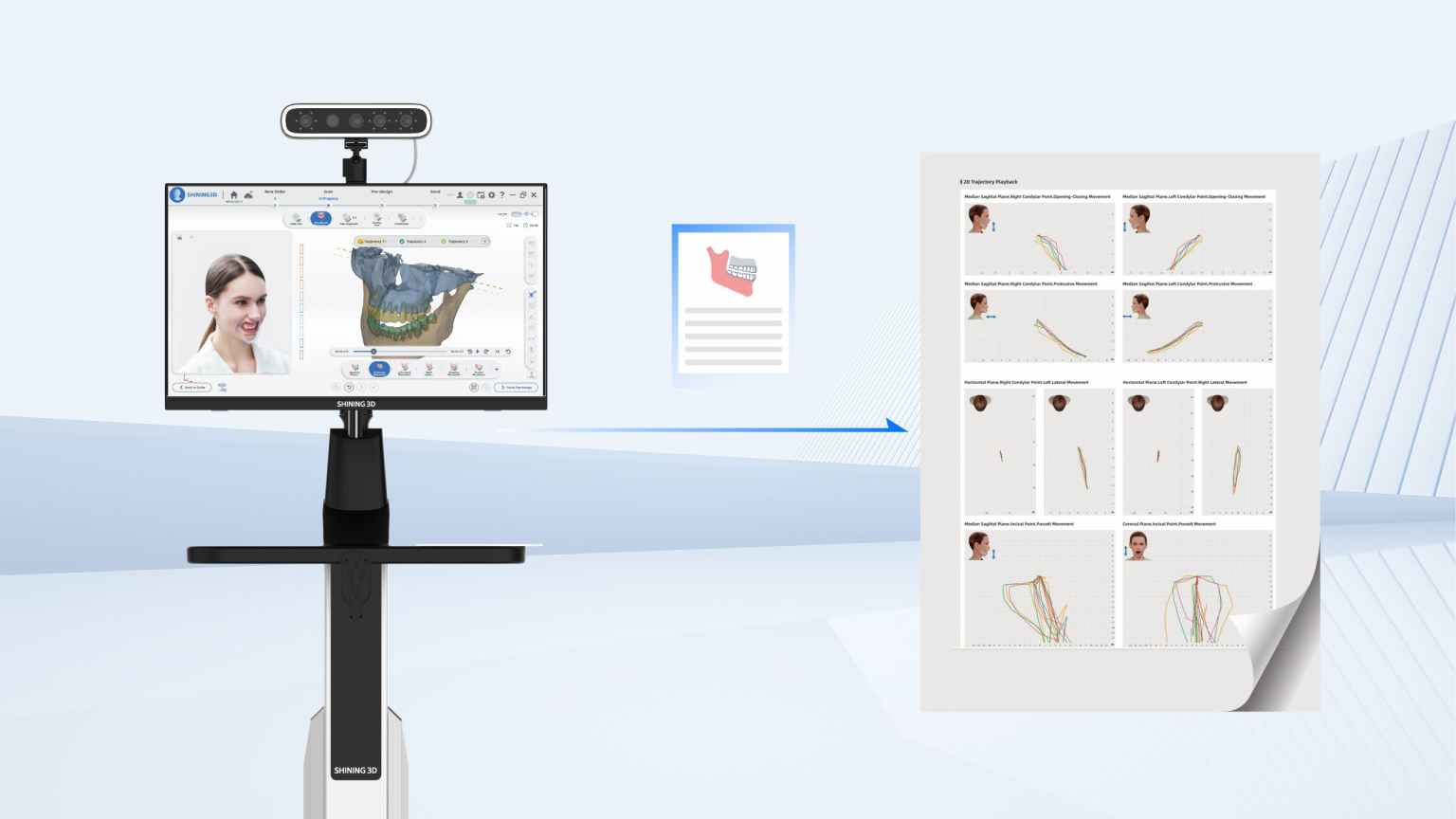
The SHINING 3D MetiSmile-MR is a facial scanner equipped with a mandibular movement tracking function. It effortlessly and accurately captures 3D face data and dynamic occlusion information using a single device.
Supported by a powerful software platform, MetiSmile-MR seamlessly integrates intraoral, facial, mandibular movement, and CBCT data, providing a comprehensive solution.
This system is particularly suitable for the diagnosis and treatment of TMJ disorders. How to treat TMJ:
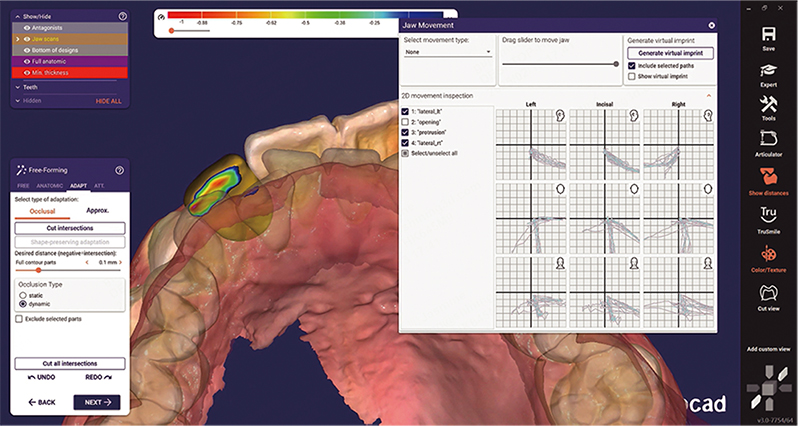
1. Mandibular Movement Trajectory Tracking
First, it captures various mandibular movement trajectories of TMD patients in real time. MetiSmile-MR offers two tracking methods: direct tooth markers and bite fork attachments, enabling precise capture of the full range of mandibular movements, including opening and closing, protrusion, left and right excursions, chewing patterns, and Posselt's envelope.
After integrating intraoral scan data, dentists can obtain digital dynamic occlusal contacts, thereby identifying and eliminating premature occlusal contacts. These objective recordings eliminate reliance on patient memory and subjective feelings.
2. Mandibular Movement Trajectory Analysis
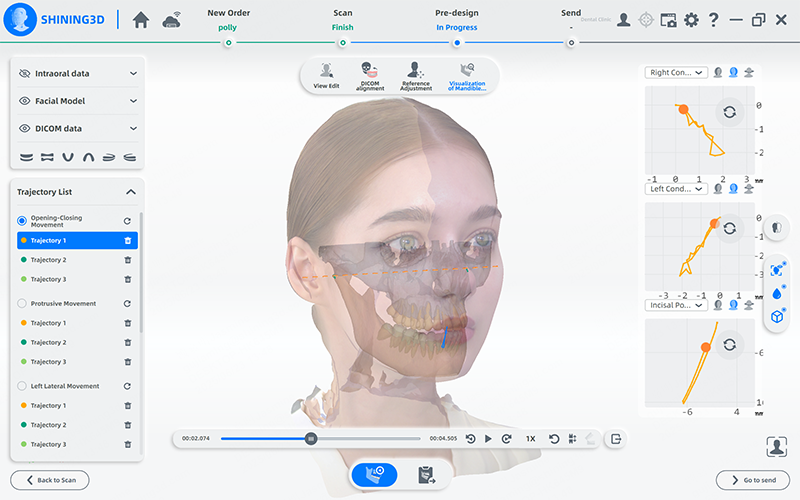
Next, the mandibular movement trajectories are integrated with the patient’s CBCT data and analyzed on the MetiSmile-MR. The system enables 3D visualization of the condylar and incisal edge motion in various directions. By projecting these movements onto standard 2D anatomical planes, it allows for precise assessment of:
l Movement Coordination: Deviations in the mouth-opening path or abnormal trajectories, common in TMD patients, are clearly captured by the system.
l Occlusal Symmetry: Comparing the movement trajectories of the left and right condyles and quantifying asymmetry.
l Occlusal Stability: Checking whether the occlusal trajectory is repeatable.
This facilitates precise diagnosis and the development of treatment plans for TMD patients.
The difference between the old and new approaches is clear:
|
Aspect |
Traditional Methods |
SHINING 3D Metismile-MR |
|
Data Type |
Static (CBCT) |
Dynamic (Real-time mandibular movement tracking) |
|
Occlusal analysis |
Articulating paper, unable to evaluate dynamic interference |
Dynamic occlusal record, identifying and eliminating premature occlusal contacts |
|
Diagnostic Basis |
Largely subjective experience |
Data-driven, objective metrics |
|
Early Detection |
Difficult, relies on obvious symptoms |
Possible through analysis of subtle movement irregularities |
Metismile-MR Integration with Digital Dentistry
The core value of the SHINING 3D MetiSmile-MR lies not only in its face scanning and mandibular movement tracking but also in its integration with digital dentistry, enabling a fully digital workflow from diagnosis to treatment.
By integrating intraoral scan data with CBCT data, it can construct a virtual patient model. The powerful software system supports:
l Direct DICOM data segmentation and automatic alignment
l Alignment and analysis of multi-modal data in one coordinate system
l Compatibility with Exocad software
This integration empowers other complex dental treatment areas:
l TMJ Disorders: As previously described, the system is an ideal tool for the precise diagnosis and development of treatment plans for TMJ disorders.
l Full-arch Reconstruction: Utilizing the “Optimal Jaw Relation” function, MetiSmile-MR determines the most suitable vertical dimension based on the theoretical difference between the Vertical Dimension at Rest (VDR) and the Vertical Dimension of Occlusion (VDO). Furthermore, it employs 30 open-close mouth movements to achieve an appropriate horizontal jaw relationship. Finally, it outputs precise prosthetic design parameters, enabling provisional restorations to be seated with greater stability.
l Orthodontics: Aligns teeth and also establishes stable, healthy occlusal function. MetiSmile MR can also simulate changes in teeth and facial appearance during orthodontic treatment, allowing patients to preview post-treatment results and simplifying doctor-patient communication.
l Smile Design: Leveraging facial scanner data, it creates smile solutions that balance aesthetics and functionality.
In summary, with the mandibular movement tracking function, SHINING 3D MetiSmile-MR not only revolutionizes the TMD treatment but also extends its applications to high-value treatments such as full-arch rehabilitation, orthodontics, and smile design, delivering innovative solutions for premium dental clinics seeking to upgrade their services.
For more information, feel free to contact us!
Share this on Social Media: