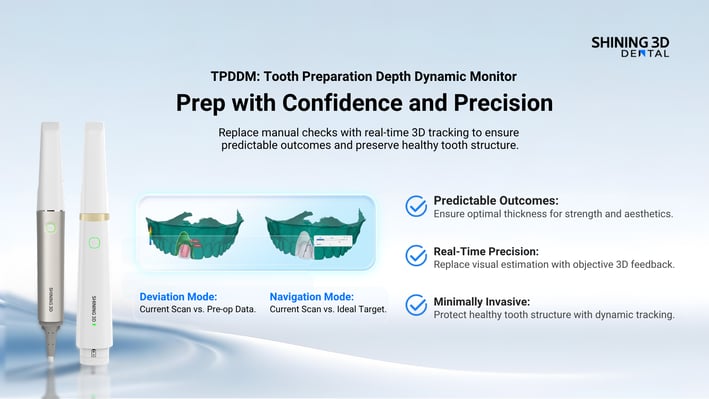
TPDDM (Tooth Preparation Depth Dynamic Monitor) redefines the experience of restorative dentistry by turning a traditionally subjective procedure into a data-driven workflow—replacing visual estimation with real-time 3D depth feedback to secure the ideal space for long-lasting restorations while preserving healthy tooth structure.
Why Traditional Tooth Preparation Still Leaves Too Much to Chance?
While digital dentistry has transformed impression-taking, CAD design, and 3D printing with micron-level accuracy, the foundational step of restorative workflows—chairside tooth preparation—often remains an analog bottleneck.
In restorative procedures, achieving the ideal preparation depth is a delicate balance. Over-preparation sacrifices healthy tooth structure, while under-preparation compromises the fit, strength, and aesthetics of the final restoration.
This is especially critical in minimally invasive treatments like porcelain veneers, where inadequate depth control directly impacts pulp vitality and enamel bonding—leading to complications like debonding or porcelain fracture.
Despite these high clinical stakes, existing verification methods still force clinicians to compromise between precision and efficiency:
-
-
- Conventional Manual Preparation: Fast and practical, yet entirely dependent on subjective experience. With a steep learning curve and no objective metrics, judging reduction depth by eye easily leads to over- or under-preparation.
-
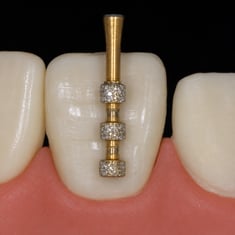
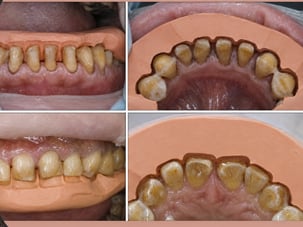
2. Silicone Indices: Provide a physical reference, but offer limited accuracy. Precision is easily compromised by putty deformation, seating position, and the coarse scale of manual probes.
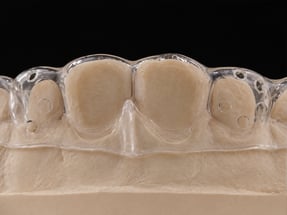
3.Digital Guides: Deliver accurate full-surface digital guidance, but require preliminary impressions, prior CAD design, and fabrication time—often forcing multiple patient visits or long chairside delays.
Introducing TPDDM: The Next Generation of Preparation Control
To solve these challenges, we are excited to introduce the Tooth Preparation Depth Dynamic Monitor (TPDDM).
TPDDM delivers a seamless, highly accurate, and fully guided monitoring solution that starts with the final restoration in mind. It is a real-time tracking tool designed to completely eliminate guesswork from your chairside workflow, providing high-precision, high-efficiency verification for a wide range of restorative procedures—from full crowns to ultra-thin porcelain veneers.
What TPDDM Does
TPDDM assists your clinical workflow through high-precision scanning and micron-level quantified preparation. It offers multi-level data comparison, multi-point monitoring, and one-click deviation measurement to guarantee preparation quality:
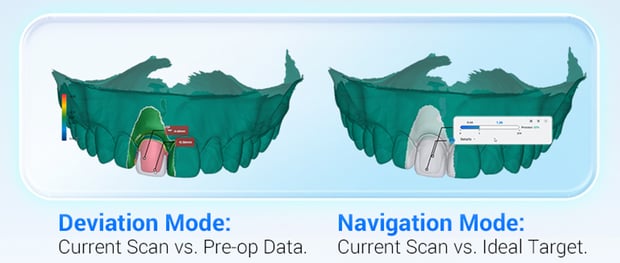
- Deviation Mode: The software directly overlays your current scan with the pre-op data to evaluate your preparation depth. You can use the heat map for a quick visual overview, or click any specific point on the tooth to see exactly how many millimeters of structure have been removed.
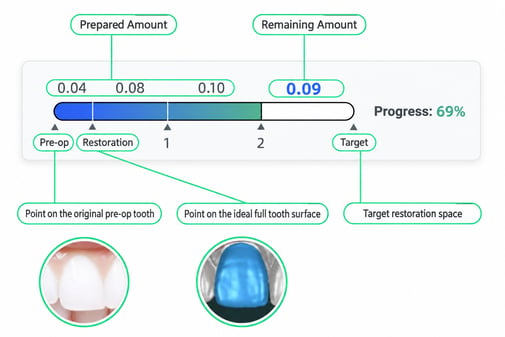
- Navigation Mode: To guide your next steps, this mode functions as a dynamic progress bar. You simply set your target depth—either by entering a manual value like 2 millimeters, or by importing a final restoration design. The system then actively tracks your scans, indicating precisely how much additional preparation is still needed to reach your goal.
Key Application Scenarios
- Minimally Invasive Aesthetics: Ideal for the measurement and control of tooth preparation in the anterior aesthetic zone, including crowns, ultra-thin veneers, and standard veneers, ensuring exact porcelain thickness requirements are met.
- Secondary Restorations: When replacing failed prostheses, TPDDM accurately assesses whether additional tooth reduction is needed for the new restorative material, preventing repeated failures caused by inadequate restorative space.
- Dental Education: In tooth preparation lab courses, students can use this system to receive immediate, quantified feedback on their preparation volume and operational habits, significantly shortening the learning curve and helping them master techniques faster.
Why This Matters
- Eliminates Manual Checks: Replaces subjective guesswork and the need for time-consuming silicone indices or 3D printed templates with objective, visual feedback.
- Minimally Invasive Care: Allows you to accurately evaluate if additional tooth reduction is needed, ensuring you preserve as much healthy tooth structure (like crucial enamel) as possible.
- Reduces Chair Time: Enables the immediate and accurate chairside evaluation of the restorative space, speeding up your workflow.
- Fewer Remakes: Avoids frustrating re-dos caused by insufficient tooth reduction and inadequate prosthesis thickness.
- Optimal Aesthetics and Strength: Ensures the final restoration has the optimal thickness required for both structural durability and aesthetic excellence.
Supported Devices
- Aoralscan Elite
- Aoralscan Elite Wireless
- Requires V3.7.1 software update or newer
How to Use TPDDM
1.Order Creation
2. Pre-op & Preparation Scanning
Share this on Social Media: